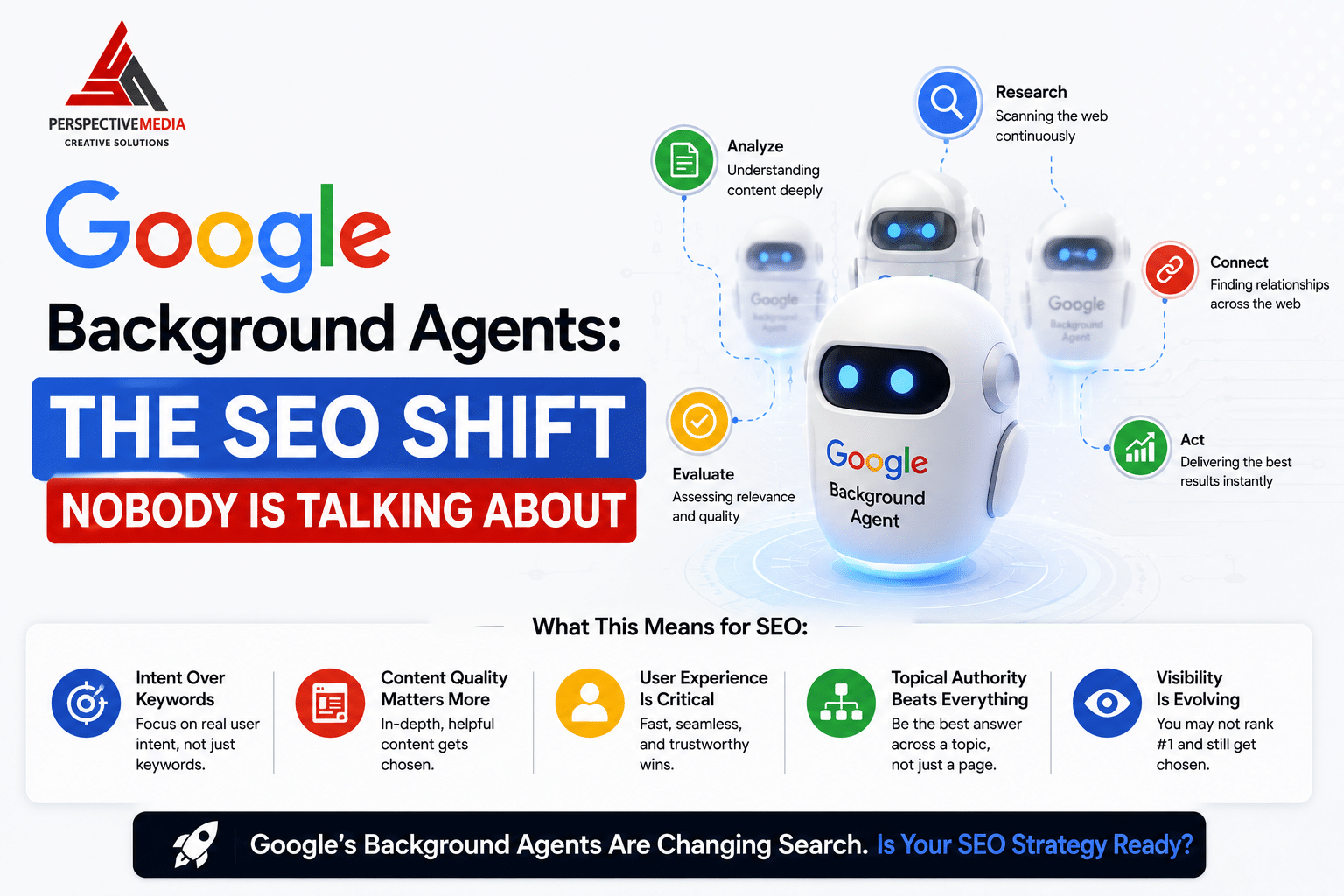
Google background agents SEO is no longer a future concept—it is the reality marketers and business owners are navigating right now, following Google’s I/O 2026 keynote on May 19, 2026. Google introduced persistent AI agents that monitor the web continuously on a user’s behalf, without the user ever opening a search results page. For any business that depends on Google for traffic, leads, or sales, this announcement represents one of the most significant structural shifts in how search works since the introduction of mobile-first indexing.
This article breaks down exactly what Google background agents are, why they change the rules of SEO, and — most importantly — what your business needs to do to remain visible in a world where users may never see a search results page at all.
What Are Google Background Agents and How Do They Work?
Google background agents are autonomous AI systems built into Google Search that operate continuously in the background without requiring user input. A user sets a standing instruction—monitor flight prices to New York, find a local plumber when rates drop, alert me when a competitor launches a new product—and the agent runs independently, scanning the web around the clock and delivering a personalized alert or recommendation when the condition is met.
Think of them as advanced, AI-powered Google Alerts — but significantly more capable. Where a Google Alert simply monitors for keyword mentions, a background agent can evaluate context, compare options, assess relevance, and deliver a synthesised recommendation directly to the user.
The critical difference from traditional search: there is no results page. The user does not type a query, see a list of ten results, and click through to your website. The agent makes the decision — based on signals it collects continuously — and delivers the outcome directly. The user may convert without ever visiting Google Search at all.
How Background Agents Collect and Evaluate Information
Background agents evaluate sources using a combination of signals that Google’s AI systems already use for traditional search—but applied continuously rather than at the moment of a single query:
- Structured and machine-readable content — can the agent parse your page accurately and quickly?
- Entity clarity — is your business clearly defined as a specific, verifiable entity with consistent information across the web?
- Freshness and accuracy—is the information on your website and Google Business Profile current, complete, and consistent?
- Authority and credibility signals—Are other reputable sources mentioning, citing, or linking to your business?
- Review data — what do real customers say, how recently, and how consistently?
Google’s official May 15, 2026, guide on optimizing for generative AI features confirmed that agents can access websites by analyzing visual renderings, inspecting DOM structure, and interpreting accessibility trees. Your site needs to be readable not just by humans but by AI systems operating autonomously.
Why Google Background Agents Change SEO Fundamentally
Traditional SEO is built around a single, linear journey: a user types a query, a results page loads, your page ranks in a position, the user clicks, and you have an opportunity to convert them. Every element of SEO strategy—keyword targeting, on-page optimization, click-through rate, and conversion rate—is built around that sequence.
Background agents break this model in two critical ways.
The End of the Single Search Moment
SEO consultant Marie Haynes summarized the shift precisely after the I/O 2026 keynote: “Currently, SEO is optimized for a single snapshot in time — a user typing a query right now. With background agents, you’re optimizing for continuous tracking.”
When a background agent is monitoring for the best local digital marketing agency or the most competitive Google Ads management service, it is not evaluating your site at one moment in time. It is building an ongoing picture of your business — your content, your reviews, your GBP data, your structured information — continuously. A business that is inconsistent, incomplete, or hard for AI to parse is a lower-confidence recommendation, and agents favor confidence.
No Results Page Means No Rankings to Rely On
This is the hardest truth for traditional SEO practitioners. When a user converts through a background agent alert, there are no search results pages. Ranking position one is irrelevant if the agent never generates a results page. The signals that matter are the ones the agent uses to evaluate your business before it ever surfaces a recommendation.
The data from the broader AI search shift already shows the direction of travel clearly. According to SISTRIX research cited across multiple I/O 2026 analyses, position-one click-through rates have already collapsed from 27% to 11% when AI Overviews are present. Background agents represent the next step in that same structural shift — not a different trend, but a continuation and acceleration of it.
How to Optimize for Google Background Agents’ SEO
The good news — and this is confirmed by Google’s own May 2026 guide — is that the actions that make your business visible to background agents are the same actions that strengthen traditional SEO. There is no separate AI-specific optimization layer required. There is, however, a higher standard for execution.
Build a Complete, Accurate, and Consistent Entity Footprint
Background agents need to be able to verify that your business is a real, specific, and trustworthy entity. This means ensuring complete consistency across every surface where your business information appears:
- Google Business Profile — every field completed, hours accurate, categories correct, photos updated
- Your website — contact information matching GBP exactly (name, address, phone number, URL)
- Directories — Yelp, Clutch, GoodFirms, Bing Places, Apple Maps, and any industry-specific directories
- Social profiles — LinkedIn, Facebook, and any platform relevant to your industry
Any inconsistency in your name, address, phone number, or service description across these sources creates ambiguity for AI systems. Agents favor businesses they can verify without confusion.
Add Structured Data That AI Can Parse Instantly
Structured data — schema markup in JSON-LD format — is how you communicate directly with AI systems in a machine-readable language. While Google’s May 2026 guide notes that structured data is not strictly required for AI search visibility, it significantly improves the accuracy with which agents understand and categorize your business.
Priority schema types for businesses targeting background agent visibility:
- Organization or LocalBusiness schema—who you are, where you operate, what you do
- Service schema — specific services with descriptions, areas served, and pricing indicators
- FAQ schema — structured question-and-answer content that agents can extract directly
- Review schema — aggregate ratings from verified sources
- HowTo schema — for process-based content that agents may surface as step-by-step guidance
Create Content That Answers Questions Directly and Efficiently
Google’s AI Director, Addy Osmani, published a content framework in April 2026, making clear that token efficiency is a real optimization factor for agent-facing content. Pages that bury their key information inside long narrative introductions are more likely to be skipped or summarized inaccurately by AI systems operating within limited context windows.
The practical implications for content structure:
- Front-load the answer within the first 200-300 words of every page
- Use clear H2 and H3 headings that signal what each section covers
- Write FAQ sections with direct, concise answers—one to three sentences per answer
- Avoid padding, repetition, and vague language that adds length without adding information
This aligns with both AEO (Answer Engine Optimization) and GEO (Generative Engine Optimization) principles. Content written for human clarity is also content written for AI efficiency. The two goals are not in conflict.
Build a Real-Time Review and Reputation System
Background agents can monitor and review data continuously. A business with consistent, recent, detailed reviews from real customers is a higher-confidence recommendation than one with outdated or sparse feedback.
Make review generation a systematic process:
- Send post-service review requests within 48 hours via email or SMS
- Respond to every review—positive and negative—within 72 hours
- Encourage specific reviews that mention services, locations, and outcomes
- Monitor reviews across platforms — GBP, Yelp, Clutch, industry directories — not just Google
Maintain Fresh, Updated Content Regularly
Agents tracking ongoing topics — pricing, availability, industry developments — favor sources that update regularly. A blog or news section updated at least twice per month signals to Google that your site is an active, maintained source worth continuous monitoring.
For service businesses, this means publishing content that addresses timely questions: Google Ads cost changes, algorithm updates, new platform features, and industry trends. This is also the highest-value content for appearing in AI Mode answers and AI overviews—so the benefit compounds.
What Local Service Businesses Should Know
There is genuinely good news in the background of the agents’ announcement for local service providers. As one analysis of the May 2026 Core Update noted, AI agents prefer pulling data directly from actual businesses rather than from directory middlemen.
If your website and Google Business Profile are accurate, complete, and optimized, AI background agents can connect customers directly to you—bypassing the aggregator sites and directories that have historically dominated local search results. This levels the playing field for businesses that invest in their own presence rather than depending on third-party platforms.
The businesses most likely to benefit are those with:
- Complete, active Google Business Profiles
- Consistent NAP data across all citations
- Real customer reviews with specific service mentions
- Clear, structured service pages on their website
- Schema markup that accurately describes their offerings
Frequently Asked Questions About Google Background Agents SEO
What is a Google background agent? A Google background agent is an autonomous AI system that monitors the web continuously on a user’s behalf, without the user needing to actively search. Users set standing instructions and receive personalized alerts or recommendations when conditions are met.
Do background agents replace traditional Google Search? Not entirely—they add a new layer of search behavior alongside traditional queries. However, they represent a significant shift in how some users discover and evaluate businesses, particularly for considered purchases and ongoing monitoring tasks.
Do I need to change my SEO strategy for background agents? Google’s own May 2026 guide confirms that AEO, GEO, and background agent optimization are extensions of strong foundational SEO — not separate disciplines. The same technical SEO, content quality, and authority signals that improve traditional rankings also improve visibility to agents.
Will background agents hurt my organic traffic? They can reduce click-through traffic for queries where agents deliver answers directly. However, businesses with strong structured data, complete GBP profiles, and genuine authority signals are more likely to be cited and recommended by agents, maintaining lead generation even without traditional clicks.
How long does it take to optimize for background agents? Technical and structural fixes — schema, GBP completion, NAP consistency — can be implemented within weeks. Content authority and review volume build over months. Starting now is significantly better than waiting.
The Bottom Line on Google Background Agents SEO
Google background agents are not a future threat to prepare for. They are live, they are growing, and they are already changing how some users discover and evaluate businesses without ever clicking through to a search results page.
The businesses that will win in this environment are not necessarily the ones with the highest keyword rankings. They are the ones with the clearest entity presence, the most structured and machine-readable content, the most consistent reviews, and the most regularly maintained web presence.
Every action that makes your business more visible and credible to an AI agent also makes it more visible and credible in traditional search. The work overlaps almost entirely. The difference is urgency — and the businesses that move now will be significantly harder to displace six months from now.
Want to know how visible your business is to Google’s AI agents right now? Get your free site audit at perspective-media.us/audit →