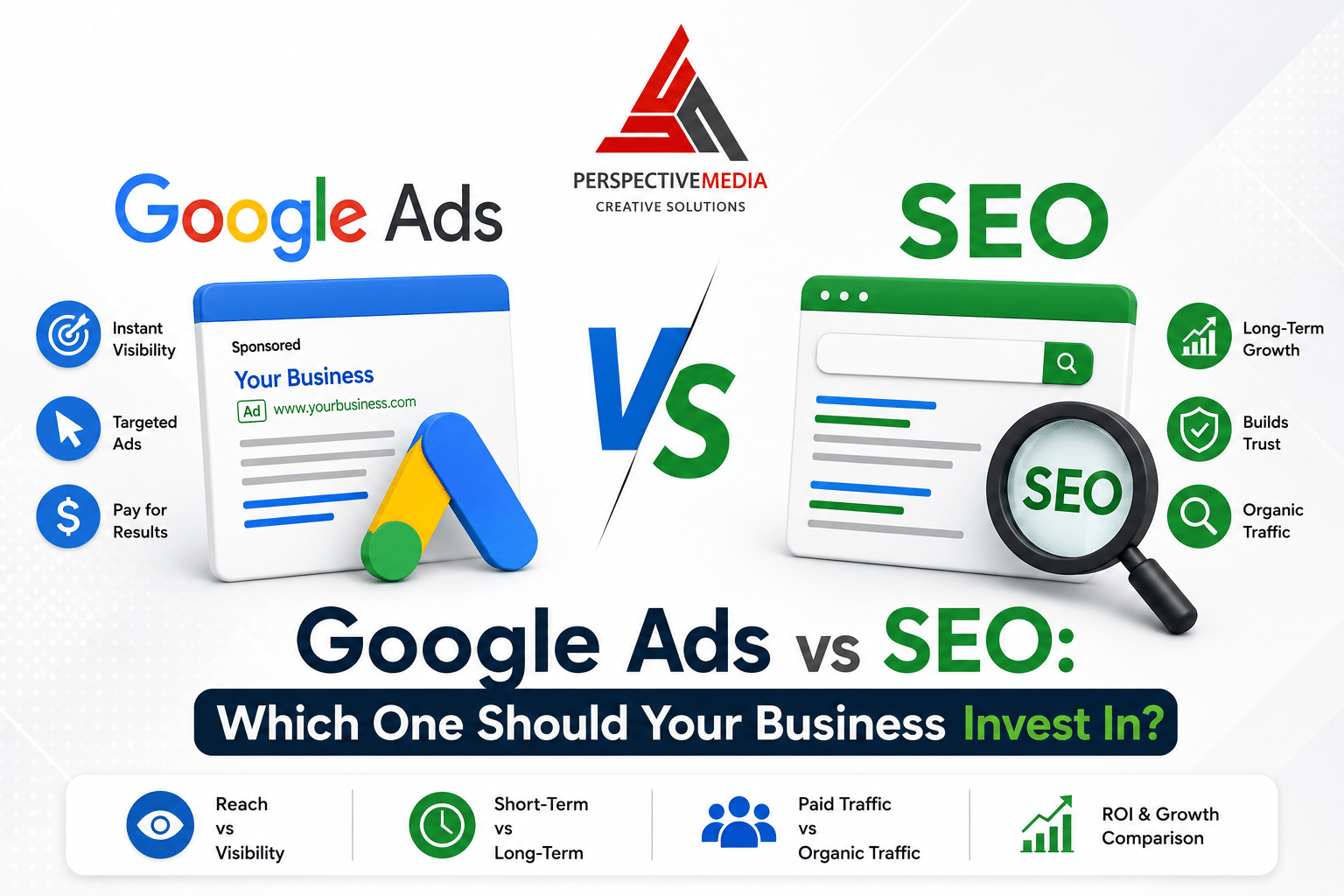
Every business owner asks the same question at some point: Should I invest in Google Ads or SEO? The honest answer is—it depends on your goals, timeline, and budget. But most businesses get this decision wrong, and it costs them.
Let’s break it down clearly so you can make the right call.
What Is Google Ads?
Google Ads (formerly Google AdWords) is a paid advertising platform that places your business at the top of search results—instantly. You pay every time someone clicks your ad (PPC—Pay Per Click).
Key facts:
- Results start immediately after campaign launch
- You control your daily budget
- The moment you stop paying, traffic stops
- Average cost-per-click in the USA ranges from $1 to $50+, depending on your industry
Google Ads is powerful for high-intent searches. Someone typing “emergency plumber near me” or “buy running shoes online” is ready to take action. Ads capture that moment.
What Is SEO?
Search Engine Optimization (SEO) is the process of improving your website so it ranks organically (for free) in Google search results. You don’t pay per click—but you invest time, content, and technical work upfront.
Key facts:
- Takes 3–9 months to see significant results
- Traffic is free once rankings are established
- Results compound over time—the longer you invest, the stronger it gets
- Requires consistent content creation, technical maintenance, and link building
SEO is a long-term asset. A well-optimized page can bring in leads every single day for years without paying for every click.
Google Ads vs SEO: Head-to-Head Comparison
| Factor | Google Ads | SEO |
|---|---|---|
| Time to results | Immediate | 3–9 months |
| Cost structure | Pay per click | Upfront investment |
| Traffic stops when… | You pause the budget | Rarely (if maintained) |
| Best for | Quick wins, launches, promotions | Long-term sustainable growth |
| Trust level | Lower (marked as “Ad”) | Higher (organic results are trusted more) |
| Scalability | Limited by budget | Unlimited with content |
When to Choose Google Ads
Google Ads makes sense when:
- You need leads now — new business launch, seasonal promotion, or testing a new service
- Your sales cycle is short, and your profit margin covers the cost per click
- You’re in a competitive market and can’t wait 6 months for SEO to kick in
- You want to test which keywords and messages actually convert before committing to SEO content
When to Choose SEO
SEO makes sense when:
- You want to build a sustainable traffic engine that doesn’t drain your budget monthly
- You’re in it for the long game—building authority, brand recognition, and inbound leads
- Your competitors are ranking organically and capturing traffic you’re missing
- You want to reduce your dependency on paid ads over time
The Real Answer: Use Both — But Start Smart
The most effective digital marketing strategies combine Google Ads for immediate results and SEO for long-term growth. Here’s a proven approach:
- Month 1–3: Run Google Ads to generate leads while SEO builds momentum
- Month 3–6: Use Ads data (which keywords convert best) to guide your SEO content strategy
- Month 6+: As SEO rankings grow, reduce ad spend on keywords you now rank for organically
This approach maximizes ROI and builds a marketing engine that doesn’t rely entirely on paid traffic.
How Much Does Each Cost?
Google Ads: Budgets vary wildly. For a small US business, $1,000–$5,000/month is a starting point in competitive industries. You’ll also need management fees.
SEO: A quality SEO engagement in the USA typically runs $1,500–$5,000+/month, depending on competitiveness. But unlike ads, the results stay even if you pause.
Final Verdict
If you have a short-term goal and need leads fast, start with Google Ads. If you want to build lasting organic visibility—invest in SEO. If you want both, build a combined strategy from day one.
At Perspective Media, we specialize in both Google Ads management and precision SEO strategy. We help businesses across the USA build systems that generate qualified leads consistently — without wasting budget on clicks that don’t convert.
Ready to find out which strategy fits your business? Get a free audit →